Coffee Stained Paper
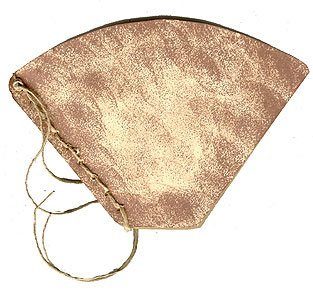
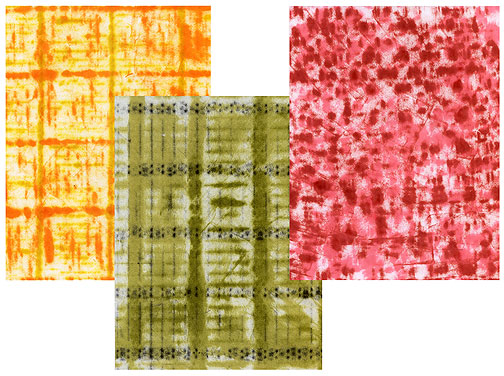
I’ve written previously about using coffee to stain coffee filters, but this week, I really needed to deeply tone a variety of different papers:
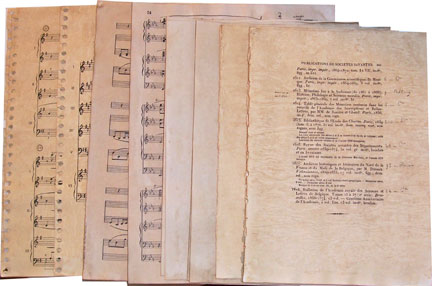
I really needed all these papers to look like they had been living in the same book for several hundred years. They were just too bright, too white, and too new-looking. A particular problem was a very white paper that I think was photocopied with an old typewritten bibliography, along with some handwritten notes. I thought with ageing, the obviously photocopied handwriting might be a little more convincing.
Ageing with coffee or tea is a pretty simple way to tone papers. I usually choose coffee over tea, because I really drink the tea I have, while I don’t drink coffee. I keep a bottle of instant coffee crystals in my kitchen for art purposes—and one large bottle has lasted me a really long time, since the expiration date on it is in 2005.
I usually start by filling a coffee cup halfway with water, and microwaving it for a minute. That heats the water enough to dissolve the coffee quickly. I use about three tablespoons of instant coffee, which makes a thick, dark brown liquid. I can always thin it later with a little water if I find I need a lighter color.
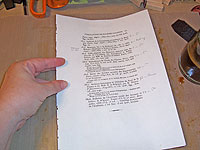
This is not a particularly speedy process, since I work one sheet at a time. In theory, I think I could toss a stack of papers into a tub of coffee liquid, then remove them individually for stacking, but I’d probably end up with a big pulpy mess in reality. Besides, there’s something really calming about staining sheet after sheet with nicely scented coffee water…
Anyway, I start by placing a sheet onto a waterproof surface. Tim Holtz was nice enough to slip me one of Ranger’s Teflon-coated craft sheets a while back, and it works just fine. A sheet of thick plastic like a heavy trash bag would also be a good work surface.
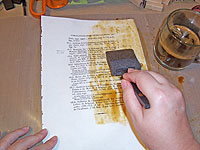
Use a sponge or a sponge brush to wipe coffee over the paper. Just work wet enough to spread the coffee around without pressure. Don’t get it so wet that the paper gets soggy. Work quickly, and try not to leave any white spots.
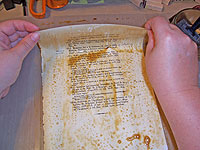
Gently lift the wet paper by the corners, pulling it up gently.
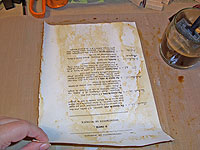
Flip the paper over onto the waterproof surface. It’s probably wet on the reverse side already. That’s OK—in fact, it’s good, because those wet parts have already started to stain. This will add to the uneven surface appearance when it dries.
Add more coffee to stain this side of the paper. Don’t work too wet—just enough to drag the stain easily over the surface, without making the paper soggy.
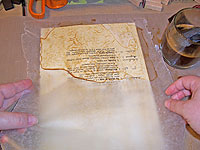
OK, now for the fun part. It’s time to lift the paper and move it to a drying area. I dry in stacks, with a sheet of waxed paper or plastic in between. I add this both to keep the wet papers from sticking together, and to add texture.
Tear off a sheet of waxed paper or plastic larger than your sheet of paper. Lay it over the wet paper. It should suck right down onto it, and create some blotchy texture immediately. Don’t smooth or press. Just let the dampness do the work of creating a good contact between the two.
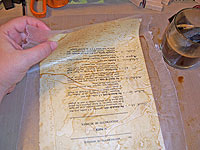
Now, reach under the top corners of the cover sheet, and lift the wet paper, pressing it back against the wax or plastic. Now, you should be able to lift both easily, with no danger of the paper tearing or turning into a soggy lump.
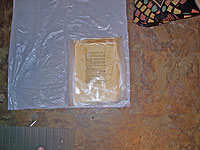
Stack papers on their cover sheets in another area. I usually do this on a sheet of plastic on the floor, which the dog just loves, because it gives him something new to sniff. Just make a big layered pile of paper, cover sheet, paper, cover sheet. Those sheets of waxed paper or plastic will keep the sheets from sticking together, and will give texture to both sides.
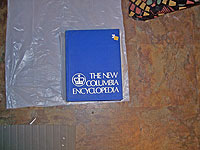
Place a waxed paper or plastic cover sheet over the last piece of paper on the pile, then weight it to dry. This is a really good excuse to own one big, heavy oversized dictionary—it makes a perfect weight for paper drying.
I let my papers dry overnight. A few were damp the next day, so I just fired up the iron, and pressed them each between two layers of light cotton muslin. Flat and crisp!
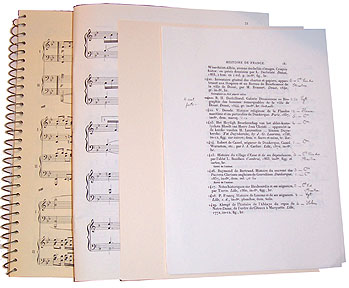
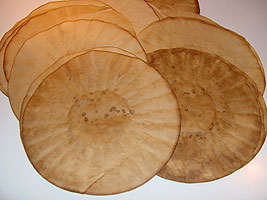
My finished papers, looking quite old and grungy. They’ve since been cut down and sorted into a new book, and now look like they belong together. Yay!
Bonus: they smell really good.
Jul 26th, 2008 at 10:07 pm
When I first saw you were talking about coffee staining, I thought, oh heck I don’t need to read that, i know how to stain with coffee.
But, I was wrong. I hadn’t ever thought of how you have done it, and I LIKE it a lot. I would have dunked the paper, I like how you painted the paper( better control and neater), then placed it in between the waxed paper to dry and to facilitate moving the paper while wet.
Guess an old dog can learn a new trick, thanks for sharing it!
Jul 26th, 2008 at 10:49 pm
I don’t care if my stuff doesn’t last a hundred years, but some folks might want longevity. It is important, therefore, to remember that coffee is highly acidic. Just thought I’d post this as every time I see something about using coffee for aging, a wee tiny voice reminds me of the acid and it’s effects on paper.
Jul 26th, 2008 at 11:03 pm
I felt the same way as the last commenter. Although after I read your technique I have decided to use it, most definitely. I already use distressing inks A LOT!! but it seems to take a little more time and effort to do each individual piece when you want that aged look. I love the idea of the the waxed paper making each piece different with less effort. I’m looking forward to stocking up on my aged papers now. Thank you so much for sharing!
Jul 26th, 2008 at 11:19 pm
I like the look of this paper. I wouldn t have thought to use the sponge brush to put the coffee on the paper but that seems to have worked great. I m just starting an altered book so I m going to get the coffee and waxed paper out and do some pages. Thanks a bunch!
Jul 26th, 2008 at 11:42 pm
@Marcia: Since I’m tearing pages out of old books, which aren’t archival to begin with, the whole acid-free thing is sort of blown out of the water from the start. I think at this point, most altered artists appreciate the natural ageing a piece undergoes over time, and tend to ignore archival issues.
Jul 27th, 2008 at 12:03 am
Lisa,
Excellent tutorial - I’m going to make myself a LARGE pot of coffee and drink some and dye some papers with the remainder. Now I know what to do when with my coffee when it goes cold because i forget to drink it ‘cos I’m crafting. LOL. Thanks a whole lot.
Jul 27th, 2008 at 2:10 am
Hello I have enjoyed your info on the coffee staining I have been thinking of ageing some light cardboard luggage tags to look aged for a new series of bears I am making and didn’t quite know how to do it like an earlier comment I probably would have just dunked. They will look good as name tags I think. I will definitely be trying this method out . Thanks very much.
Jul 27th, 2008 at 4:34 am
I recently found a bunch of Italian novels at an Estate sale. So after reading your artical I pulled some out and WOW I love your technique with the foam brush and the waxed paper. I usually would spritz or sponge the coffee on to the paper. But I like the control of the foam brush. And the aroma of coffee fills the air as they dry. A couple were a little damp so I pressed them with a hot iron in between the waxed paper. Great results!!!
Thanks for sharing.
Jul 27th, 2008 at 6:27 am
I recently discovered coffee staining and this is definitely a trick that I need to distress some music scores I found.
Jul 27th, 2008 at 1:33 pm
Thanks for this tutorial. I have never tried coffee staining and probably would have used the coffee out of the pot instead of instant coffee. I am definitely adding a small jar of instant coffee to my shopping list this week to try this techinque.
Jul 27th, 2008 at 1:54 pm
Excellent resource..easy to follow instructions.
I enjoyed the comments from other artists as well.
This will be a technique I will use in my altered books.
Being a tea drinker as well, time to get some coffee.
Jul 27th, 2008 at 6:46 pm
Great tutorial, I think coffee smells better than it tastes too!
I need to do this soon I think. Hope we’ll see the book you made too?
Jul 27th, 2008 at 10:17 pm
This is one of the best ideas ever. I have coffee stained pages before, but only one at a time and then had to wait days to use them. I can’t wait to get a few minutes to paint a whole bunch. And iron them…who would have thought. I also stuck it in a plastic container and soaked it in coffee and then had a ripped and torn piece. I guess there is always a better way.
Jul 27th, 2008 at 11:08 pm
I also like the technique of using the sheets of waxed paper and the sponge brush to apply the coffee. I would have to agree about the archival issue - the paper isn’t acid free to begin with but if one is concerned about the long term longevity of the paper, one way to preserve it better would probably be to seal what ever project it’s being used for with a matte sealant. I could be wrong but that may help it survive longer.
Jul 27th, 2008 at 11:16 pm
The best new information in this tutorial is the placing wax paper over the wet page and using it as a stabilizer so it won’t tear! Genius!!
Barb
Jul 27th, 2008 at 11:35 pm
Great new technique. Like the others stated, I’ve done coffee staining and like it a lot but have never added the wax paper element for a more distressed look. LOVE IT!
Jul 27th, 2008 at 11:50 pm
Since I make a lot of paper, I like to dry my paper on sheets of felt, and overnight will usually do it. In the summer, I’ve had paper dry in a few hours this way. However, this tends to give a more even color tone. The plastic or waxed paper is still the best way for that ‘uneven’ look that enhances the aged appearance. Great tutorial!
Jul 28th, 2008 at 2:04 am
Loved the reminder about coffee staining technique, I have not done any pages in quite awhile. To add to what you said, sometimes i pinch some of the dry instant coffee crystals on the wet coffee stained paper to give it a little more texture. I also used an old cookie sheet as my “base” before getting a craft sheet. This technique works great on shipping tags, lace, rickrack, twill…til there is not a drop of coffee left!
Jul 28th, 2008 at 2:31 am
I appreciate your clear, detailed instructions which make it easy for someone who has not tried a technique like the coffee ageing process to decide to give it a go. Thank you for sharing.
Jul 28th, 2008 at 4:24 am
This sounds like a great way to stain lots of sheets at once. But since I LOVE coffee, I always have a little left in the pot and sometimes use it to stain small things, like ATC’s, or some bits of lace. I’m wondering if there would be different results with instant coffee, like you used, and cold brewed coffee, like I use.
Hmmmmm……looks like some research is in order. Thanks Lisa!
Jul 28th, 2008 at 4:45 am
Oh, the coffee never makes it to the paper, so had to get some walnut ink..hee hee. I also like to use unsweetened kool-ade and flavored teas for paper coloring. Yep, when I run out of walnut ink, back to the coffee. I enjoyed reading all the tips of other items to stain. I might add white plastic buttons will take the color also. Lots of objects to give a warm wash of coffee color! Your tutorial was very well written and easy to understand, thank you.
Jul 28th, 2008 at 5:16 am
I, too, appreciate your clear tutorials. Every time I read one, I learn something new. I don’t like the smell of coffee, but I am going to try this method with tea staining on my next go round. I never though of sticking the wax paper between the wet sheets, I’ve always just laid them out one next to the other. Lovely to learn a new trick. Thank you.
Jul 28th, 2008 at 9:05 am
Love the use of plastic between the sheets. Maybe I’ll sprinkle a couple of coffee granules on the wet surface before stacking the papers. It’s good to play:) Annie P
Jul 28th, 2008 at 11:14 am
This is one of my favorite aging techniques. I am a huge coffee drinker and usually use whatever is left in the pot. Sometimes I can do a bunch sometimes not so much. Of course the added scent is a bonus too.
Jul 28th, 2008 at 1:48 pm
What about using a cutting board as a waterproof surface? Seems like that might work. I’m going to try it today.
Thanks!
Jul 28th, 2008 at 3:52 pm
Wowie! I’ve done some coffee staining, but this is fabulous. The texture is the key here, and I couldn’t think how to do it.
Jul 28th, 2008 at 4:10 pm
I love this article. I have stained tags before using flavored teas (particularly raspberry as it leaves a nice pink color)but never coffee. Using wax paper is a great idea I haven’t tried and I’m looking forward to the texture that technique will add to my papers!
Jul 28th, 2008 at 9:01 pm
i cant wait to try this technique i have tea stained fabrics but never tried staining paper i want to try spraying the coffee on paper also cm
Jul 29th, 2008 at 12:40 am
Hi Lisa!
I love this technique, especially because you can age the papers in batches! Beautiful results, too!!!
Big happy hugs,
Rebecca
Jul 31st, 2008 at 11:52 pm
Thanks for this article! I have been wanting to do this and I thought I knew how, but your step by step instructions made clear I really didn’t.
Aug 12th, 2008 at 7:52 am
Great tutorial as usual! I’ve stained paper with coffee mixed with cinnamon, then baked at a low temp.in the oven for a few minutes on a large cookie sheet. The paper is a little wavy in texture and smells great. This is fun to do if making cards for the holidays! (The smell lasts for a long time.)
Aug 12th, 2008 at 1:19 pm
My daughter inadvertently invented a super easy tea staining technique. She was playing with my used tea bag in a restaurant and I was about to scold her when I noticed how well the bag was staining her napkin. My jaw dropped.
How easy is this?
Make a cup of tea
Remove the teabag
Drink the tea
Dab the wet teabag on the paper you want to stain.
Aug 16th, 2008 at 2:42 pm
Like one or two ( or more ) of your commenters here, I have tried using coffe and tean in the past without being very impresssed. BUT the idea of drying between sheets of plastic to achieve texture seems to add another dimension and I will definitely be giving it a another go. Thanks for the tip, and the clear instructions